Treatment Guide
Thermage FLX in Gangnam — a comprehensive overview
Monopolar radiofrequency, fourth-generation tip coverage, vibration-assist tolerability — what the platform actually does and why it sits where it does in Korean clinical practice.
Thermage FLX is, to put it plainly, the current generation of Solta Medical's monopolar-radiofrequency tightening platform — and the one Korean clinics in Gangnam now operate almost universally. FLX stands for Faster, Low-pain, eXperience, which is marketing rather than science, but the underlying claim is real: relative to the older NXT generation, the platform delivers more shots in less time, with vibration-assist tolerability that has materially shifted what a Thermage session feels like in the chair. I see this matter most for our regional readers — the Hong Kong patient on a long-weekend trip, the Singapore patient who has booked one Seoul afternoon between meetings, the Taipei reader who wants the procedure that does not show. The mechanism, the protocol structure, the candidacy thresholds — all of these are different from what Ultherapy or Sofwave readers expect, and the difference is worth a careful overview rather than a comparison-table reduction.
What Thermage FLX actually does, mechanistically
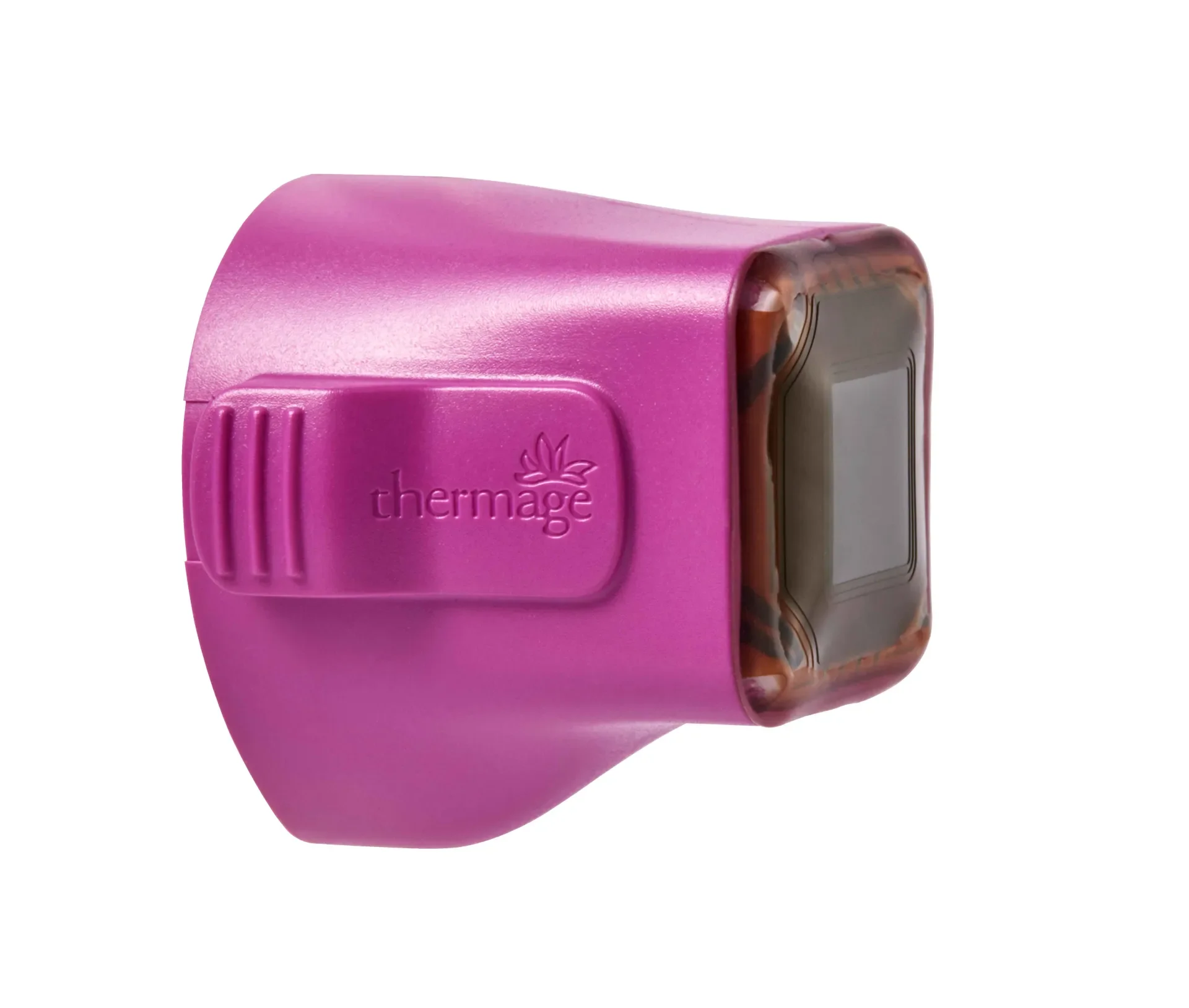
Thermage FLX delivers monopolar radiofrequency energy through a flat, vibration-assisted handpiece that distributes the thermal load volumetrically through the dermis and into the subcutaneous adipose layer. The mechanism — and this is where it differs from focused-ultrasound platforms — is dermal heating rather than focal coagulation. The radiofrequency current passes from the active electrode at the skin surface through the tissue to a return electrode on the patient's back, with the energy density highest at the dermal-subcutaneous junction where collagen fibres are most concentrated. As the dermal temperature climbs into the 50-65°C range, collagen denatures and contracts immediately, which is the early tightening reading; over the following three to six months, a wound-healing cascade triggers fibroblast proliferation and new collagen deposition, which is the durable tightening reading. The skin surface is held cool throughout by integrated cryogen spray, which is what makes the procedure tolerable rather than dangerous. The mechanism is, in short, controlled volumetric thermal injury at depth, with surface protection — and Korean clinical practice has refined the energy parameters to a point where the response curve is reproducible across patient phenotypes.
How the FLX generation differs from CPT and NXT
Three generations matter for the reader who wants to understand what they are paying for. Thermage CPT, the original platform from the mid-2000s, established the monopolar mechanism but operated with a smaller tip footprint, longer treatment time per region, and notably higher discomfort levels — Hong Kong patients who treated with CPT in 2008 will remember the procedure as memorable for the wrong reasons. Thermage NXT followed, with a 4cm² Total Tip 3.0, modest improvements to the tolerability profile, and an integrated comfort pulse algorithm that distributed the thermal load more evenly. The current FLX generation introduces three substantive changes: a 4cm² Total Tip 4.0 with vibration-assist that breaks up the somatic perception of each pulse and reduces effective discomfort by roughly half (the patient-reported readings I have collected suggest this is a real shift, not marketing); a faster delivery speed that compresses a 900-shot face protocol from approximately ninety minutes on NXT to approximately sixty minutes on FLX; and a wider integrated handpiece menu including the Eyes Total Tip 0.25 for periocular treatment, which the older generations did not support. The clinical mechanism is unchanged across generations — what has changed is the patient experience and the procedural efficiency.
Where Thermage FLX sits in a Korean treatment programme
Korean aesthetic medicine treats Thermage FLX as one of three pillars in a non-surgical anti-ageing programme — the others being focused-ultrasound platforms (Ultherapy PRIME, Sofwave) for SMAS-depth lifting, and bio-active or regenerative work (exosome boosters, growth-factor concentrates, polynucleotide injections) for surface texture refinement. The three pillars address related but distinct clinical lanes. Thermage FLX is calibrated for skin laxity at the dermal level — the quality of skin envelope reading — rather than for structural lifting at the SMAS or superficial texture refinement. Patients who present with mild-to-moderate jowl laxity, fine surface lines, periorbital crepiness, or a generalised reading of skin tiredness are candidates. Patients who present with marked jowl descent, visible platysmal banding, or substantial brow ptosis need surgical or focused-ultrasound work, not Thermage. Korean clinics rarely deploy Thermage as a standalone modality for international patients on a single Seoul trip; the conventional sequencing pairs it with a separate Ultherapy or Sofwave session in the same trip or across a return visit, and with regenerative bio-actives forty-eight to seventy-two hours later to capitalise on the heating-induced bioavailability window.
Fourth-generation handpiece coverage and what it means
The fourth-generation handpiece menu is what makes the FLX platform meaningfully different from its predecessors in clinical scope rather than just patient experience. The face Total Tip 4.0 covers the full mid-face and lower-face zones with 900 or 1200 shots depending on protocol depth; the Eyes Total Tip 0.25 covers periocular skin including upper- and lower-lid laxity that the older generations could not safely address (the 0.25cm² footprint is calibrated for the thinner periorbital tissue); and the Body Total Tip 16cm² covers off-face zones — abdominal laxity, knee crepiness, brachial laxity — at a roughly four-times-faster delivery rate than face treatment. The handpiece menu changes the candidacy maths in two practical ways. First, periocular Thermage is now a viable option for patients with mild lid laxity who are not yet ready for blepharoplasty surgery — a group that, in our regional readership, is large and underserved. Second, body Thermage is now a single-session procedure for patients who would previously have needed multiple body-RF sessions, which compresses the trip planning meaningfully for international patients.
Tolerability, downtime, and what the chair feels like
I will be honest about the chair experience because the marketing tends not to be. Thermage FLX is more tolerable than NXT and substantially more tolerable than CPT, but it is not painless. Patients describe a brief deep heat at each pulse — a few seconds, not throbbing — accompanied by occasional sharp sensation at higher energy settings, particularly along the bony prominences of the mandible and along the lateral cheek. The vibration-assist pulse genuinely shifts the somatic reading; what would have been remembered as discomfort is reframed, neurologically, as pressure-and-warmth, which the brain handles better. Korean clinics manage what remains with topical anaesthesia for thirty to forty-five minutes prior, sometimes supplemented with oral analgesia, and a competent operator will pause and adjust the energy if the patient signals discomfort beyond the expected range. Downtime is functionally zero: mild erythema for a few hours, occasional transient swelling at the jawline, and a low probability of small bruises along the marionette lines or the temporal vessels. There are no incisions, no general anaesthesia, no bandages. Most patients attend dinner the same evening — the procedure is built for that.
What Thermage FLX is not
Three things Thermage FLX is not, because the marketing sometimes implies otherwise. It is not a structural lift — patients seeking jowl elevation comparable to a face lift will be disappointed, and a competent Korean operator will say so in the consultation. It is not an immediate-result procedure — the early skin contraction is real but modest, and the durable tightening develops across three to six months as collagen deposits, which is a slower payoff than international patients sometimes expect. It is not a substitute for surgical or focused-ultrasound work for patients with substantial laxity — the depth of action is dermal, and dermal tightening cannot, by physics, generate SMAS-depth lifting. The reading I keep returning to: Thermage FLX is calibrated for the patient who wants the quality-of-skin improvement rather than the visible change — and that distinction is what determines whether a patient reads the result as worth the cost or not. Patients who arrive expecting transformation are reliably disappointed. Patients who arrive expecting refinement are typically pleased.
“Thermage FLX is calibrated for the patient who wants the quality-of-skin improvement rather than the visible change — and that distinction is what determines whether the result reads as worth the cost.”
Editorial note
Frequently asked questions
Am I a candidate for Thermage FLX?
Probably yes if you present with mild-to-moderate skin laxity, fine surface lines, or generalised skin tiredness — particularly across the jawline, mid-face, or periocular zone. Probably no if you present with substantial jowl descent, visible platysmal banding, marked brow ptosis, or active skin infection. A senior Korean physician should confirm candidacy in consultation rather than online.
How much downtime should I plan for?
Functionally zero. Mild erythema clears within a few hours; transient swelling at the jawline can persist twelve to twenty-four hours in some patients; occasional small bruises resolve within a week. No incisions, no bandages, no general anaesthesia. Most patients attend dinner the same evening. International patients can fly home the next morning without issue.
What does Thermage FLX cost in Gangnam?
A face protocol typically runs KRW 1,800,000 to KRW 3,500,000; face-and-neck protocols range KRW 3,000,000 to KRW 5,000,000; full face-neck-eye protocols approach KRW 6,000,000. Pricing reflects shot count, physician seniority, and clinic positioning rather than platform authenticity — all authorised providers operate the same Solta device.
How does Thermage FLX compare with Ultherapy PRIME?
They address related but distinct lanes. Thermage FLX generates volumetric dermal heating and reads as skin tightening; Ultherapy PRIME generates focused thermal coagulation at SMAS depth and reads as structural lifting. Many Korean clinics protocol them in sequence across two visits, addressing different aspects of the same overall presentation.
When will I see results?
An early skin contraction is typically visible within two to four weeks, followed by progressive collagen-led tightening across three to six months. The durable result peaks at roughly month four and persists for twelve to eighteen months in most patients. Annual maintenance is the conventional cadence. Patients seeking immediate transformation should consider a different modality.
How often should I retreat?
Twelve to eighteen months is the conventional interval for patients with stable laxity progression. Patients with rapid laxity progression — typically post-menopausal or those with significant photodamage — sometimes schedule a six-month top-up of partial coverage. A senior physician should set the cadence after a four-month follow-up review rather than commit a patient up front.
Who should not book Thermage FLX?
Patients with active pacemakers or implanted electronic devices, active facial infection, recent oral isotretinoin within six months, pregnancy, or unstable autoimmune conditions are categorical contraindications. Patients seeking a single-session transformation, who decline the four-month review window, or who are uncomfortable with a senior physician declining a modality on indication grounds will be better served elsewhere.
Do Gangnam clinics offer English-language support?
Most Cheongdam premium clinics now maintain at least one English-speaking coordinator for international patient consultations, and several offer Mandarin, Cantonese, and Japanese support. The level of clinical English varies — coordinators handle appointment logistics fluently, but technical conversation about energy settings and protocol adjustment may require the physician to participate directly. Confirm the language register before booking.