Treatment Guide
Thermage FLX for the eye area — Total Tip 0.25, depth, and the lid laxity question
An editorial reading of periorbital Thermage FLX in Gangnam: how Total Tip 0.25 operates at controlled depth in the thinnest facial skin, how lid laxity is classified, and what the procedure can and cannot do for the eye area.
The eye area is the zone Thermage FLX is asked to do its most delicate work on, and it is also the zone where the procedure most often disappoints when the operator treats periorbital skin with the same protocol used for the cheek. The editorial reading on the eye area — refined across post-procedure interviews with Hong Kong, Singapore, Taipei, and Tokyo patients — is that periorbital outcomes depend on a calibrated combination of the correct tip (Total Tip 0.25), the correct depth (shallower than the standard face tip delivers), and an honest reading of the patient's lid laxity stage. Patients arrive in Gangnam asking about eyelid tightening as if it were a single procedure with a single answer; what actually predicts the result is whether the lid laxity sits within the modality at all, whether the periorbital skin tolerates a meaningful pulse density, and whether the operator integrates the Total Tip 0.25 zone with the broader full-face grid in a way that produces a coordinated thermal effect across the upper face. What follows is the reading on periorbital-specific Thermage FLX in Gangnam — the device, the depth, the expectations, and the lid laxity question that determines whether the procedure is the right modality at all.
The Total Tip 0.25 — what it actually is
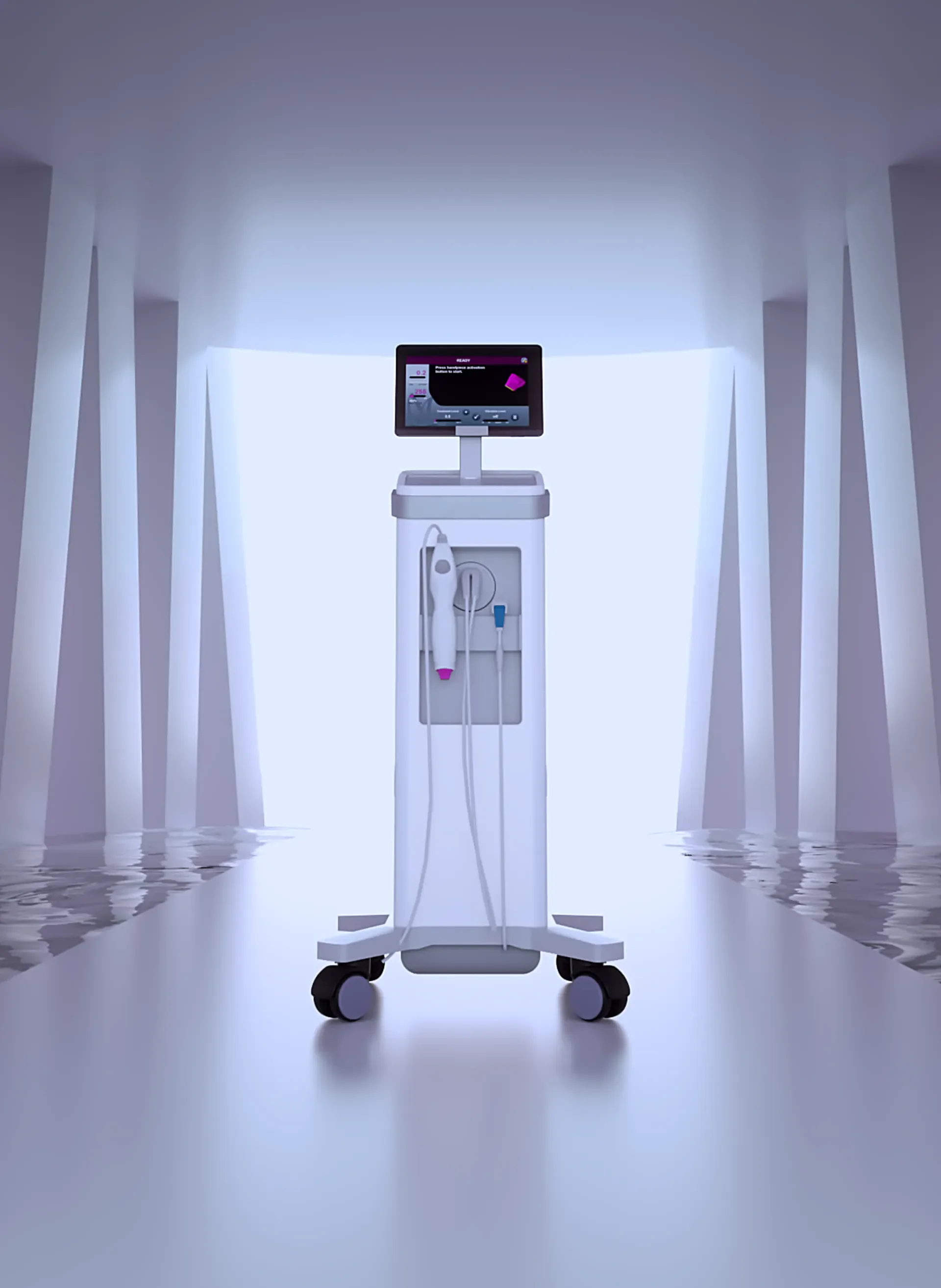
The Total Tip 0.25 is the dedicated periorbital handpiece in the Thermage FLX system, calibrated for the thinnest facial skin and delivering radiofrequency at a shallower controlled depth than the standard face tip. The mechanism, in editorial reading: the standard face tip delivers thermal energy at a depth appropriate for the cheek and lower face, where the dermis is thicker and the subcutaneous fat layer provides thermal buffering. The periorbital skin is, anatomically, the thinnest facial skin — significantly thinner than the cheek dermis, with minimal subcutaneous fat between the dermis and the underlying orbicularis oculi muscle. Delivering the standard face tip pulse depth into this zone risks thermal injury to the underlying structures and produces an inconsistent dermal heating profile in the target tissue. The Total Tip 0.25 resolves this through a smaller treatment tip, a shallower controlled depth, and a delivery protocol designed specifically for the periorbital architecture. Patients should ask the operator whether the eye area work is performed with the Total Tip 0.25 specifically, rather than as an extension of the standard face grid. A senior operator at a Gangnam premium clinic will recognise the question and answer it specifically; an operator who treats the periorbital zone as a continuation of the full-face protocol is producing a weaker periorbital result than the modality is capable of and, in the worst case, introducing thermal risk to structures the tip is not calibrated for.
Depth control — the technical question that determines safety and result
Depth control in the periorbital zone is the technical question that determines both the safety profile and the visible result of eye area Thermage FLX. The dermatology literature on monopolar radiofrequency in thin skin describes a controlled thermal injury zone calibrated to dermal collagen specifically, with minimal thermal effect on the underlying muscle, fat, or vascular structures. The Total Tip 0.25 is engineered to deliver this controlled depth profile in periorbital tissue; the standard face tip is not. What this means practically for the patient. First, the visible result. The Total Tip 0.25 produces a measurable but modest tightening reading in the upper eyelid skin, the lateral orbital rim (the crow's feet zone), and the lower lid skin above the malar fat pad. The shift is real but conservative — the editorial reading insists on naming this clearly because patients arriving with surgical-level expectations are routinely disappointed. Second, the safety profile. The Total Tip 0.25 carries a clean safety record in the published literature and in practice-level reading at Gangnam premium clinics. Transient erythema across the periorbital zone for several hours post-procedure is the most common observation; persistent adverse events are rare in operator-experienced hands. Third, the operator dependency. The depth control on the Total Tip 0.25 is calibrated by the system, but the placement of the pulse, the cadence, and the integration with the full-face grid are operator-dependent. A senior operator with high periorbital Thermage volume produces a more consistent result than a junior operator using the same device on the same patient.
Lid laxity classification — the question that matters before the device
Lid laxity is the zone-specific reading of soft-tissue and dermal slackness in the periorbital region, and it is the question that should be answered before the device question. The editorial reading on lid laxity classification: stage one (mild dermal slackness, intact lid contour, no visible redundant skin draped over the lash line, no significant lower lid festoon) responds well to Total Tip 0.25 periorbital Thermage FLX with a visibly measurable tightening across the four-month timeline. Stage two (clear dermal slackness with mild redundant skin in the upper lid crease, partial loss of lateral orbital firmness, early lower lid laxity without significant festoon) responds partially — the periorbital tightening is real and the visible shift is measurable, but the procedure alone will not restore the lid contour of an earlier decade. Stage three (significant redundant skin draped over the lash line, marked lateral orbital descent, visible lower lid festoon or pseudo-herniated fat pads) is, in the senior physician's reading, outside the modality. Patients in this category are typically better served by a conversation about surgical blepharoplasty, blepharoplasty-adjacent combination protocols, or a different non-surgical modality calibrated for higher-stage lid laxity than Thermage FLX is engineered for. The most important consultation question for periorbital patients: what is my lid laxity stage, and what specifically can the procedure do for me? The senior physician's answer should be specific, not aspirational, and should explicitly name the lid laxity stage rather than describe the procedure in general terms.
Expectations vs full-face — managing what the periorbital procedure produces
Expectation management is the editorial work that has to happen before the procedure rather than after. Patients booking eye area Thermage FLX in Gangnam often arrive with one of two expectation patterns, and both patterns produce disappointment when left uncorrected. The first pattern is the surgical-expectation pattern — the patient who expects the procedure to deliver the lid contour change of a blepharoplasty. This pattern produces a four-month review in which the patient concludes the procedure did not work because the periorbital reading at Month 4 is meaningfully improved but does not approach surgical transformation. The second pattern is the full-face equivalence pattern — the patient who expects the periorbital tightening to read as proportionate to the cheek and lower face tightening the same Thermage FLX session produces. This pattern produces a four-month review in which the patient is satisfied with the lower face result but reads the eye area as barely changed. The reading on this is that the periorbital procedure is, by design, more conservative than the full-face procedure — the Total Tip 0.25 operates at lower energy and shallower depth, and the visible shift it produces is appropriately modest. Patients booking the periorbital add-on should plan for a Month 4 result that reads as a refinement of the eye area rather than a transformation. A useful framing: the periorbital procedure earns its keep when paired with the full-face procedure on the same trip, producing a coordinated upper-face-and-lower-face reading at Month 4. As a standalone periorbital-only procedure, the result is measurable but conservative.
How periorbital Thermage FLX integrates with the full-face protocol
The senior operator's reading on periorbital Thermage FLX is that the procedure produces its strongest result when sequenced as an add-on to the full-face protocol on the same trip. The mechanism is partly logistic — patients flying in for the procedure rarely return for a periorbital-only session, and the full-face plus eye area combination is the conventional Gangnam protocol — and partly clinical. The full-face thermal effect on the cheek and lower face produces an integrated tightening reading across the lower two-thirds of the face; the periorbital Total Tip 0.25 work then refines the upper third in a way that reads as proportionate at Month 4. Patients who book periorbital-only sessions sometimes report an asymmetric Month 4 reading in which the eye area looks slightly refreshed but the rest of the face has not moved, which the editorial reading describes as the modality working as expected but read poorly because the visual context is incomplete. The pricing reflects this: a full-face plus Total Tip 0.25 protocol in Gangnam typically prices the periorbital add-on at a meaningful discount to the standalone periorbital procedure, which is the practice-level signal that the combination is the conventional protocol. A senior physician will sometimes recommend the combination over the standalone periorbital procedure for this reason, even when the patient initially books periorbital-only. The right reading on the question is that the consultation drives the decision, not the patient's pre-booking preference.
The four-month timeline for periorbital Thermage FLX
The periorbital result follows the same four-month timeline as the broader Thermage FLX result, with a slightly compressed visible-shift profile. The immediate post-procedure window produces transient erythema across the periorbital zone for several hours and rare mild swelling that resolves within twelve to twenty-four hours. The Day 7 reading is essentially neutral — patients with baseline photographs sometimes notice a subtle refinement around the lateral orbital rim; patients without baseline photographs rarely notice anything. The Week 2 to Week 4 collagen response produces a measurable upper lid and lateral orbital tightening that becomes visible in casual mirror reading by Month 2. The Month 3 to Month 4 durable peak produces the procedure's full visible result — a refined upper lid contour, a tightened lateral orbital rim, and a subtle upward refresh of the lower lid skin. The result persists for twelve to eighteen months in stable laxity progression. The four-month review with the senior physician is, as with the full-face procedure, the relevant data point for evaluating whether the procedure delivered for the specific periorbital presentation. Earlier readings — at Day 7, at Week 2, at Week 6 — are premature and routinely undersell the eventual periorbital refinement.
“The Total Tip 0.25 is a refinement instrument, not a transformation instrument — and patients who book the procedure understanding that distinction are almost always satisfied with the result.”
Editorial note
Frequently asked questions
Can Thermage FLX replace a blepharoplasty for me?
No, and the editorial reading insists on naming this clearly. The Total Tip 0.25 periorbital procedure produces a measurable dermal tightening across the upper lid, lateral orbital rim, and lower lid skin. It does not produce the structural lid contour change a surgical blepharoplasty does. Patients in stage three lid laxity with significant redundant skin draped over the lash line are outside the modality. A senior physician consultation is the right way to read whether your lid laxity sits within the procedure's capability.
Is the Total Tip 0.25 safe for the eye area?
Yes, in operator-experienced hands. The tip is engineered specifically for periorbital skin with a shallower controlled depth profile that minimises thermal effect on underlying structures. The published safety literature is clean for the device in indicated use. Transient erythema for several hours is the most common observation. Operator dependency is real — the device safety profile is calibrated, but the placement, cadence, and integration with the full-face grid depend on the senior operator's experience.
How much does the Total Tip 0.25 periorbital add-on cost in Gangnam?
Adding the Total Tip 0.25 to a full-face Thermage FLX protocol typically costs KRW 600,000 to KRW 1,200,000 incremental at premium Gangnam clinics. A standalone periorbital-only Total Tip 0.25 session typically prices higher per unit than the add-on configuration, which is the practice-level signal that the combination is the conventional protocol. Confirm the quote breakdown before booking — what is included and what is not.
Will the procedure help with crow's feet specifically?
The lateral orbital rim — the crow's feet zone — is one of the procedure's stronger reading zones. The dermal tightening across this region reads as a refinement of the static rhytid pattern and a slight reduction in the dynamic rhytid depth. Patients seeking complete crow's feet smoothing often pair the procedure with a dynamic rhytid modality on a separate trip. The combination produces a coordinated lateral orbital reading that neither modality achieves alone.
When will I see the eye area result?
The Day 7 reading is essentially neutral. The Week 2 to Week 4 collagen response produces a measurable upper lid and lateral orbital tightening. The Month 2 reading becomes visible in casual mirror review. The Month 3 to Month 4 durable peak is the relevant data point — a refined upper lid contour, a tightened lateral orbital rim, and a subtle lower lid refresh. Earlier readings are premature. Patients should plan a four-month review with the senior physician for the honest result.
How does the eye area procedure feel during the session?
The periorbital pulse intensity is meaningfully lower than the full-face pulse, calibrated for the thinner skin and the shallower target depth. Most patients describe the eye area portion as a series of brief warm sensations rather than the more pronounced heating reading of the cheek and lower face. The comfort pulse vibratory mechanism is engaged across the periorbital zone as well. Topical anaesthesia preparation runs thirty to forty-five minutes pre-procedure.
Should I book the periorbital procedure as a standalone session?
The senior operator's reading is that the procedure produces its strongest visible result when sequenced as an add-on to the full-face protocol on the same trip. Standalone periorbital-only sessions are clinically appropriate but tend to read as an asymmetric Month 4 result — the eye area refines but the rest of the face has not moved. The combination produces a coordinated upper-face-and-lower-face reading that neither configuration achieves alone.
How long does the eye area result last?
Twelve to eighteen months in stable laxity progression, consistent with the full-face Thermage FLX result. Patients with rapid periorbital laxity progression — common in patients with significant sun exposure history or smoking history — sometimes schedule a partial-coverage top-up at eight to twelve months. The senior physician should set the retreatment cadence after the four-month review rather than commit the patient up front. Annual maintenance is the conventional planning baseline.