Treatment Guide
Thermage FLX devices and tip generations
Two device generations matter most — and within FLX, four handpiece footprints determine what the protocol can address.
If you are reading this you have probably noticed that Korean clinic pages tend to describe Thermage FLX in language that elides the device-level distinctions — the 900-shot and 1200-shot references float past without much explanation, the Eyes Total Tip arrives as a footnote, and the comfort pulse is sometimes presented as a feature you might toggle on like a stereo equaliser. The reality is more useful and more interesting than that. The Thermage FLX platform operates with a consistent radiofrequency generator and cryogen-cooled treatment console, and what changes from session to session is the disposable handpiece — the tip — that determines footprint, depth, and energy distribution. Understanding the tip generations is, in my reading, the single most useful piece of pre-consultation knowledge a patient can bring into the chair, because it determines what protocol the operator can actually deliver and what the shot-count quote on the price list means.
The 900-shot and 1200-shot face protocols, in plain English
The shot count on a Thermage FLX face protocol is the total number of monopolar radiofrequency pulses the operator delivers across the treatment region — and the difference between a 900-shot and a 1200-shot protocol is dose, distribution, and price rather than a different device. Both run on the same Total Tip 4.0 face handpiece, which has a 4cm² active surface and is calibrated for the dermal-subcutaneous junction. A 900-shot face protocol covers the mid-face and lower-face zones at standard density — roughly 225 shots per quadrant, with a moderate energy setting. A 1200-shot protocol extends coverage into the lateral cheek, the marionette region, and a denser jawline pass, and it sometimes incorporates a higher energy setting that drives a stronger thermal injury and, correspondingly, a stronger tightening response. Korean clinics typically quote 900-shot protocols at the entry tier and 1200-shot protocols at the standard tier, with full face-and-neck protocols running 1500 to 2000 shots and full face-neck-and-eye protocols running 2000 to 2500 shots. The shot count is the protocol; the device is the same.
The Eyes Total Tip 0.25 — what it is and why it matters
The Eyes Total Tip 0.25 is, in my reading, the most clinically interesting addition to the FLX platform. It is a 0.25cm² active footprint — substantially smaller than the face Total Tip 4.0 — calibrated for periocular skin including upper- and lower-lid laxity. The smaller footprint is not a downgrade; it is a precision instrument. The thinner tissue around the orbital rim cannot tolerate the energy density that the 4cm² face tip delivers without risking unwanted thermal injury to the orbital fat pad, the conjunctiva, or the underlying lid musculature. The 0.25cm² tip distributes a calibrated lower energy across a smaller, more precisely targeted area, which makes periocular Thermage a viable option for patients with mild lid laxity who are not yet ready for blepharoplasty surgery. The clinical reading is modest tightening of upper-lid hooding, mild reduction of lower-lid crepiness, and a refinement of the periocular skin envelope that pairs particularly well with patients whose primary concern is looking tired rather than looking older. The older NXT and CPT generations did not support periocular treatment at this safety profile — the Eyes Total Tip is a meaningful expansion of candidacy, not just a marketing bullet.
Body Total Tip — for off-face zones, at speed
The Body Total Tip operates at 16cm² active surface — four times the footprint of the face tip — and is calibrated for off-face zones where the dermis is thicker and tighter and the cosmetic concern is broader-area laxity rather than fine line refinement. Korean clinics protocol Body Thermage for abdominal laxity post-pregnancy or post-weight-loss, brachial laxity (the inner upper arm), knee crepiness, and occasional thigh applications. The larger footprint accelerates delivery rate by roughly four times relative to face treatment, which means a body protocol that previously required multiple RF sessions can now compress into a single one to two-hour visit. The candidacy pattern is narrower than for face Thermage — patients with substantial subcutaneous fat respond less well, and patients with heavy stretch-mark disruption of the dermis respond unpredictably — but for the right candidate the result reads as meaningful tightening that holds for twelve to eighteen months. International patients on a multi-day Seoul trip often pair body Thermage with a face protocol scheduled forty-eight hours apart, which the body's recovery profile tolerates without difficulty.
Comfort pulse vs the original delivery
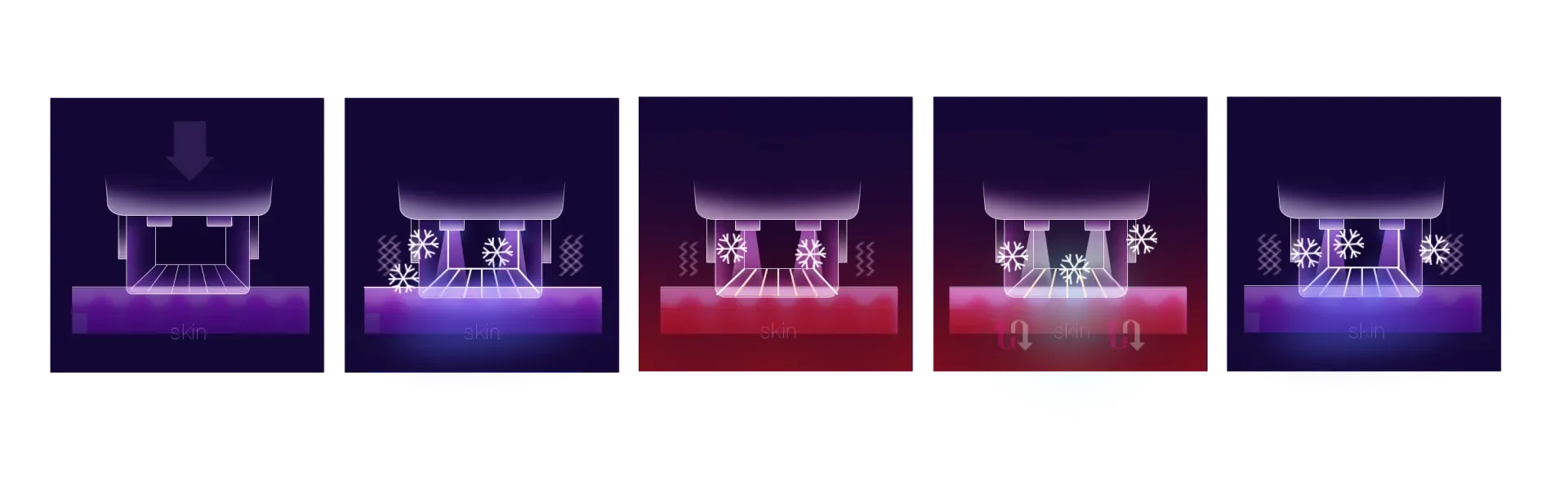
Comfort pulse is the algorithmic delivery refinement that distinguishes the FLX generation's chair experience from the older NXT and CPT generations. In the original delivery mode — which the older platforms used as their default — the radiofrequency pulse arrived as a single short, intense thermal load, and the patient's somatic perception of each pulse was a brief sharp heat that the brain registered as discomfort. Comfort pulse fragments the same total energy across a series of shorter sub-pulses delivered in rapid succession, with the cryogen cooling and vibration-assist synchronised between sub-pulses. The total energy delivered to the dermis is identical; the perceived discomfort is materially lower because the somatic registration of pressure-and-warmth dominates the sensory channel rather than the sharp-thermal-pulse signal. The clinical effect is unchanged — collagen denatures and contracts at the same threshold regardless of how the energy is fragmented. What changes is whether the patient remembers the procedure as tolerable. The older NXT generation introduced a primitive version of comfort pulse; the FLX generation refined it with vibration-assist to the point where most patients describe the chair experience as firm pressure with warmth rather than sharp heat. Korean clinics now operate FLX exclusively in comfort pulse mode for international patients.
Authentic vs counterfeit Thermage — how to verify
Counterfeit and grey-market Thermage devices are a persistent concern in regional aesthetic medicine, particularly in markets outside Korea where the regulatory framework is less stringent. Korea, fortunately, operates a strict authorised-provider system — every Thermage FLX device legally imported into Korea is registered with Solta Medical and the Korean Ministry of Food and Drug Safety, and the disposable tips are individually serialised. International patients can verify authenticity in three ways. First, ask the clinic to show the device console — the FLX console has a distinct interface and a registered serial number visible on the device, and a competent operator will not hesitate to confirm. Second, ask to see the disposable tip packaging before it is opened — the genuine packaging carries Solta's holographic seal, batch numbers, and a QR code linking to the manufacturer's verification portal. Third, cross-reference the clinic's name against Solta's published authorised-provider list for Korea. Korean clinics in Cheongdam and the broader Gangnam corridor are almost universally authentic; counterfeit risk is materially higher in markets where authorised-provider verification is less accessible.
Tip storage, single-use protocol, and the disposable economics
A note on the disposable economics, because it shapes the pricing structure international patients see on Korean clinic price lists. Each Thermage FLX tip is a single-use disposable — once activated, the tip cannot be re-used on a different patient or even on a return visit by the same patient. The tip itself accounts for a meaningful share of the per-procedure cost, and the shot count quoted on the price list reflects the maximum capacity of the tip rather than a flexible budget the operator can adjust mid-procedure. A 900-shot protocol uses a 900-shot tip; a 1200-shot protocol uses a different, higher-capacity tip. Korean clinics do not, as a rule, share tips between patients or attempt to extend a tip beyond its rated capacity — the device firmware enforces the single-use protocol electronically, and authorised providers risk their certification by attempting otherwise. The economic implication for patients is that more shots means a different tip with a different procurement cost, and the price difference between a 900-shot and a 1200-shot protocol is not arbitrary clinic margin but a real device-cost differential plus the additional operator time.
“The shot count is the protocol; the device is the same. Understanding what that means is the single most useful piece of pre-consultation knowledge a patient can bring into the chair.”
Editorial note
Frequently asked questions
Is the 1200-shot protocol meaningfully better than the 900-shot?
It depends on candidacy. For patients with moderate-to-significant laxity, the 1200-shot protocol's denser jawline pass and lateral cheek coverage produces a stronger tightening reading. For patients with mild laxity, the 900-shot protocol delivers most of the available benefit at lower cost. A senior physician should set the protocol after assessing the laxity distribution rather than defaulting to the higher tier.
How much downtime does a 1200-shot protocol have versus 900?
Functionally identical — both protocols leave the skin with mild erythema for a few hours and occasional transient swelling at the jawline for twelve to twenty-four hours. The downtime is determined by the energy distribution rather than the shot count itself. International patients can fly home the morning after either protocol without issue.
What does a Thermage FLX session cost in Gangnam?
A 900-shot face protocol typically runs KRW 1,800,000 to KRW 2,800,000 in Gangnam. A 1200-shot protocol runs KRW 2,500,000 to KRW 3,500,000. Adding the Eyes Total Tip 0.25 typically adds KRW 600,000 to KRW 1,200,000. Body Total Tip protocols vary widely by treatment area and run KRW 2,000,000 to KRW 5,000,000.
How does Thermage FLX compare with Ultherapy PRIME?
They address related but distinct lanes. Thermage FLX generates volumetric dermal heating via monopolar radiofrequency and reads as skin tightening. Ultherapy PRIME generates focused thermal coagulation at SMAS depth via micro-focused ultrasound and reads as structural lifting. Many Korean clinics protocol them in sequence across two visits.
When will I see results after Thermage FLX?
Early skin contraction is typically visible within two to four weeks. Progressive collagen-led tightening develops across three to six months. The durable result peaks around month four and persists for twelve to eighteen months in most patients. Annual maintenance is conventional. Patients seeking immediate transformation should consider a different modality.
How often should I retreat?
Twelve to eighteen months is the conventional interval for stable laxity progression. Patients with rapid laxity progression sometimes schedule a six-month partial-coverage top-up. A senior physician should set the cadence after a four-month review rather than commit a patient up front.
Who should not book Thermage FLX?
Patients with active pacemakers or implanted electronic devices, active facial infection, recent oral isotretinoin within six months, pregnancy, or unstable autoimmune conditions are categorical contraindications. Patients seeking a single-session transformation, who decline the four-month review window, or who are uncomfortable with a senior physician declining a modality on indication grounds will be better served elsewhere.
Do Gangnam clinics offer English-language support for FLX consultations?
Most Cheongdam premium clinics now maintain at least one English-speaking coordinator, and several offer Mandarin, Cantonese, and Japanese support. Coordinators handle appointment logistics fluently; technical conversation about energy settings and tip selection may require the physician to participate directly. Confirm the language register before booking.